
More important than ever in these times…
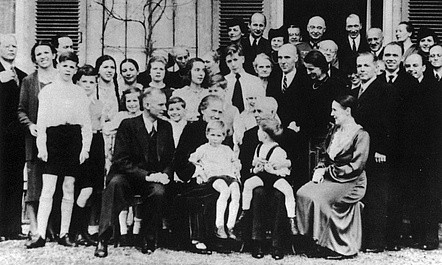
The photo, taken on the terrace of Paula and Karl Bonhoeffer’s retirement home at Marienburger Allee 43 in Berlin, now the Bonhoeffer House–Memorial and Place of Encounter, shows the birthday party. Dietrich can be seen on the far left. Five days later, Dietrich Bonhoeffer was arrested by the Gestapo in this house.
On February 4, we celebrate Dietrich Bonhoeffer’s 120th birthday. The life and work of the theologian and resistance fighter would have been unthinkable without his family. At the end of March 1943, they gathered one last time to celebrate Karl Bonhoeffer’s (seated, second from right) 75th birthday.
The celebration must have been like a brief light in a long, dark night for everyone. Many years later, guests still talked about the children’s symphony by Joseph Haydn performed by the grandchildren, the festive meal, and the lively conversations that lasted late into the evening. An ideal world—but only at first glance. The faces of the party guests reveal that the mood was anything but carefree. Dictatorship, war, and persecution had cast a dark shadow over those gathered. Dietrich’s twin sister Sabine, her husband Gerhard Leibholz, and their children were unable to attend. They had already left the country in 1938 because of “Gerd’s” Jewish heritage. Many friends had also gone into exile. A month before the party, the last Berlin Jews who had been spared deportation until then had been arrested in a raid. The family was very aware of all this; they also knew about the extermination of Jews in concentration camps. Dietrich Bonhoeffer (far left) and especially his brother-in-law Hans von Dohnanyi (not pictured) were involved in activities to bring people who were persecuted as Jews to safety abroad.
When the photo was taken, the family had long been in the Gestapo’s crosshairs because of their opposition to National Socialism. Shortly afterwards, the Nazi regime struck brutally.
Dietrich Bonhoeffer was arrested at his parents’ house five days after the photo was taken. His sister Christine (next to Dietrich) and his brother-in-law Hans von Dohnanyi were also picked up by the Gestapo on April 5, 1943. After the failed assassination attempt on July 20, 1944, Dietrich’s older brother Klaus (2nd row, 4th from right), his brother-in-law Rüdiger Schleicher (bald in the center), and his friend Eberhard Bethge (right next to Christine) were also arrested. Dietrich and Klaus Bonhoeffer, Hans von Dohnanyi, and Rüdiger Schleicher were sentenced to death for their resistance to the dictatorship and murdered in April 1945, just a few days before liberation by the Allies.
The house of Paula and Karl Bonhoeffer, Dietrich’s parents, was the center of the family and their large circle of friends. Here they worked and played music, discussed and argued, celebrated and mourned, laughed and cried. Whenever Dietrich Bonhoeffer was in Berlin, he lived on Marienburger Allee. He wrote parts of his unfinished book Ethics in the attic room. And last but not least, numerous conspiratorial meetings of very different opponents of the Nazis took place here.
Is there a better place to reflect on how we want to live together, what values guide us, and how we can stand up for the rule of law and democracy? Is there a more suitable place to understand what “church for others” and what being a Christian means today? Is there a more memorable place to learn crucial lessons about the dangers of political extremism, nationalism, and any form of exclusion of people?
Anyone who has ever visited this house and felt its special spirit understands that we need this place—in times when the rule of law and democracy are under threat as never before since 1945, perhaps more urgently than ever. Every year, thousands of people from all over the world come to Marienburger Allee to understand the attitude from which the Bonhoeffers resisted and to take something away from it for their own lives. They are inspired by the exhibition, get involved in the numerous events, or seek quiet prayer in Dietrich Bonhoeffer’s study.
The Protestant Church in Berlin bought the house decades ago and established a Memorial and Place of Encounter here that documents and passes on the spirit and attitude of the Bonhoeffer family. A dedicated team of volunteers has been filling the house with life for almost four decades. A non-profit association is responsible for the work, organizes guided tours of the exhibition, designs seminars, and invites visitors to readings and lectures. For the first time in the history of the house, a full-time employee has been supporting the work for a good year now. He coordinates an extensive development and professionalization process and initiates numerous projects himself.
However, this important work cannot be continued or expanded unless additional resources can be secured. The Bonhoeffer House does not receive any permanent, structural funding. We therefore ask for your support: become a supporting member of the association or help with a donation. If you would like to help the house move on to its next chapter and are able to provide more extensive support, please feel free to contact the board at any time.

Dr. Tobias Korenke
Great-nephew of Dietrich Bonhoeffer and deputy chairman of the supporting association at the Bonhoeffer House
donate to IBAN: DE24 1005 0000 0190 6448 77 or online via https://www.betterplace.org/en/projects/163982
becoming a supporting member: mitgliedschaft.bonhoeffer-haus-berlin.de
contact us